
Read Summary
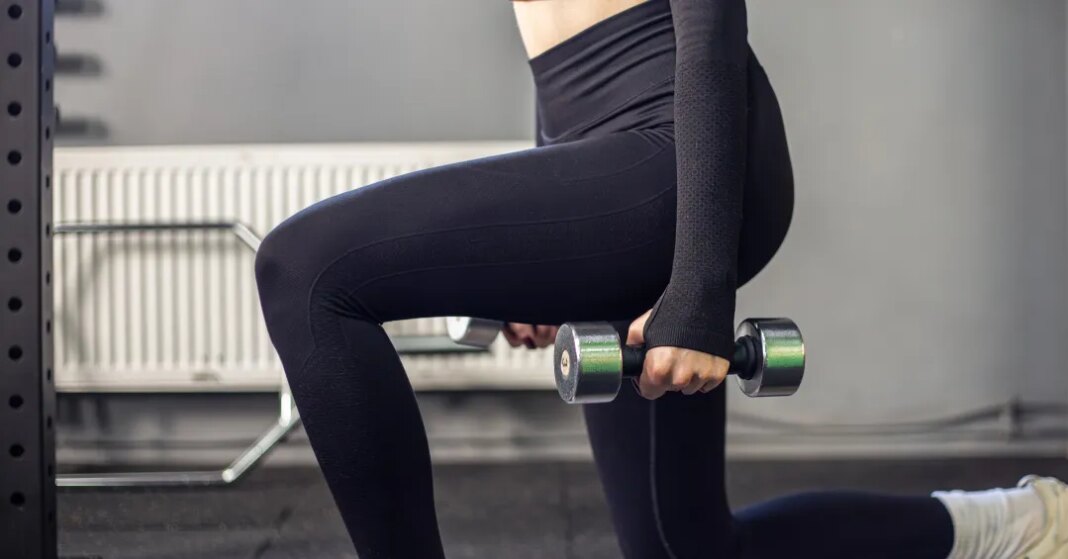
A lunge with dumbbells It is a good exercise for those who want to develop their leg and glute muscles. The multi-joint movement also works on balance and stability, helping to strengthen the trunk region, which makes it a good alternative for those with back problems.
A good option for strength and hypertrophy training, the dumbbell lunge mobilizes the quadriceps, femoral, hamstring (back of the thigh) and gluteus maximus muscles, it is a complete exercise for leg training.
How to do it?
To perform the lunge, as the name suggests, the first step is to grab the dumbbells. But it’s important to be calm at this point, especially if you’re a beginner: it’s best to give priority to lower loads and focus on a good execution. As you get the hang of it, you can gradually increase the loads to avoid any injuries.
With the dumbbells in your hands, you should stand with your arms extended at your sides and your knees slightly bent. So, with one leg, take a step forwardsquatting.
Take care to keep your torso vertical at all times, and keep looking straight ahead. With the leg that made the stride, push your body back to the starting position. This exercise is unilateralthen you must repeat the same process with the other leg.
Now, just repeat the movement for as many repetitions as you want.
So as not to make mistakes
The dumbbell lunge is a simple movement, but its correct execution requires attention to detail. In addition to taking care of your posture, it is also important to pay attention to the movement of your knees during the exercise.
One of the most common errors is dynamic valgus knee: when the knee turn inward during the downward movement of the exercise. During the squat, it is important to pay attention that your knees remain “straight” throughout the exercise.
Another classic mistake is that of descend too much during the strideto the point that the knee touches the floor. Leaning the knee on the floor is completely unnecessary to perform the exercise and imposes an unnecessary impact on the patella, which can lead to injuries.
Watch your knee
Generally, this exercise is not recommended for those who already have a knee problem, as it puts tension on that part of the body. But the movements can be adapted according to each person’s capabilities and limitations.
Of course, at this time the assistance of a professional is ideal. Furthermore, the movement can be replaced by others that mobilize the same muscle group, such as the normal or Bulgarian squat, stationary stride, unilateral leg press, among others.